DUNLOP Group's mainstay products, i.e., tires, use natural rubber as their raw material—a vital asset provided by nature. To procure natural rubber on a long-term and sustainable basis, we recognize the need to consider not only quality, cost, and delivery (QCD) but also environmental and human rights issues and ensure that it is a sustainable resource. To make natural rubber production sustainable, we will make efforts to resolve issues in our supply chain, including collaboration with all people involved in natural rubber. Through these efforts, we will provide our customers with joy and well-being.
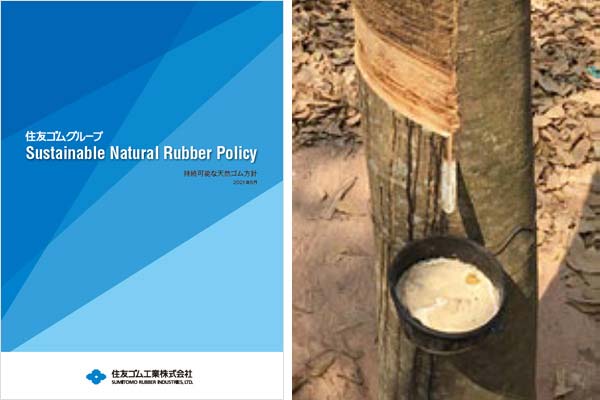
In September 2018, the Company participated in Global Platform for Sustainable Natural Rubber (GPSNR). In November 2018, we also formulated our Sustainable Natural Rubber (SNR) Policy which reflects a policy framework approved by the GPSNR, with the aim of gearing up efforts to resolve issues in regions where natural rubber is produced, such as environmental problems caused by the destruction of forests and human rights problems in the working environment (revised in August 2021).
Based on this updated SNR Policy, we proactively promote collaborative initiatives with all companies in our supply chain to realize the sustainable procurement of natural rubber.
※ Global Platform for Sustainable Natural Rubber
Our group is advancing integrated biodiversity initiatives, centered around the Sustainability Management Promotion Headquarters and in collaboration with top management and all departments. To promote sustainability management, we convene the Sustainability Promotion Committee twice a year. Chaired by the Sustainability Officer and comprising departmental officers as members, this committee ensures thorough implementation of company-wide policies and monitors progress on materiality issues.
Working groups are established under the Sustainability Promotion Committee. The Biodiversity Working Group, as one such group, advances initiatives through a cross-departmental organization.
In line with our fundamental Sustainable Natural Rubber Policy philosophy, the Group has established Procurement Guidelines to achieve sustainable procurement.
For information on the EcoVadis assessment, please refer to the “Supply Chain Management: EcoVadis” section.
The world’s demand for natural rubber has increased nearly three-fold over the past 40 years.
This is attributable mainly to population growth and the rapid spread of motorization worldwide. In the face of these trends, people are concerned about issues such as illegal deforestation, land grabbing, and violation of human rights, and the possible impact of forest destruction and unlawful deforestation on biodiversity in the natural rubber supply chain.
Approximately 85% of natural rubber is produced by small-scale farmers, called smallholders, rather than plantation operators. Natural rubber plantations, especially those operated by smallholders are faced with issues such as poverty due to the shortage of knowledge and know-how on harvesting rubber, and the increasing burden on ecosystems.
Moreover, many of the regions where natural rubber is produced are located in tropical rainforests adjacent to fertile lands that are home to many rare species. The expansion of natural rubber plantations may endanger the lives of these species.
The natural rubber supply chain is comprised of many stakeholders around the globe, including approximately 6 million smallholders as well as plantations, dealers, and natural rubber processors, which has made the supply chain highly complex. Further, some transactions are made across the boundaries of regions and countries. Therefore, it is extremely difficult to clarify (to ensure the traceability of) the distribution route from a producer to a processing plant of natural rubber. However, it is becoming increasingly important to understand the supply chain for natural rubber and conduct risk assessments along the supply chain. Furthermore, it is becoming necessary to identify and procure the natural rubber that has limited risk in terms of forest destruction and human rights violation. Additionally, the TNFD framework is utilized for analyzing both risks and opportunities within this context.
* Tracing the route from production and processing to distribution so as to inspect farm crops, products, etc.
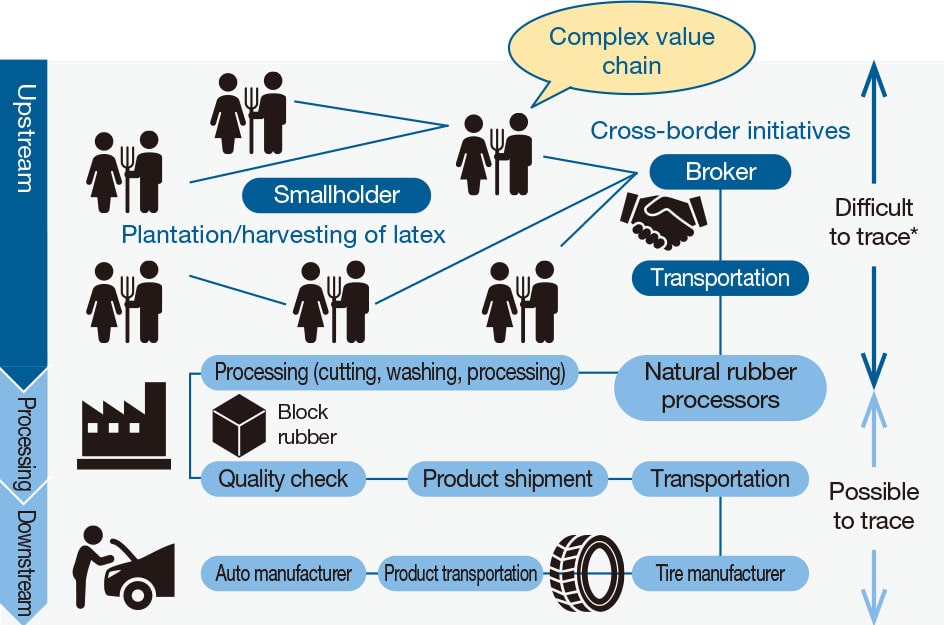
The DUNLOP Group will collaborate with supply chain stakeholders and relevant industry organizations to identify regions with high risks of environmental destruction, human rights violations, and other compliance violations by incorporating new technologies and innovations such as supply chain mapping. We will accurately assess the impact of these risks on residents and other stakeholders, and strive to avoid and reduce risks by enhancing traceability in the supply chain.
To ensure sustainable natural rubber procurement, the DUNLOP Group believes it is extremely important that we identify risks in our natural rubber supply chain. Therefore, we have implemented RubberWay®, the environmental and social risk assessment tool dedicated to natural rubber since July 2023. This tool statistically analyzes huge amounts of questionnaire data to assess the magnitude of environmental and social issues and displays the assessment results on the map. This tool covers 10 natural rubber-producing countries, and the assessment items include, but not limited to, deforestation, water resource management, forced labor, and child labor.
By using RubberWay® effectively, we will assess/identify risks in the natural rubber supply chain and develop measures to mitigate such risks to contribute to the sustainable procurement of natural rubber.
* An application software developed by Michelin, Continental, and the software developer SMAG
Our group is advancing initiatives such as industry-wide collaboration and EUDR compliance system development to ensure that everyone from management to field departments understands our commitment to natural rubber sustainability and can reliably comply with the EUDR. As part of industry-wide efforts, we also contributed to creating EUDR compliance guidelines (Operational Guidance) for natural rubber processors within the GPSNR (Global Platform for Sustainable Natural Rubber). Furthermore, we are advancing efforts toward EUDR compliance, including conducting visits to natural rubber processors and audits of their EUDR readiness (2025: On-site audits conducted for 96% of SRI-G's EUDR NR procurement suppliers), as well as utilizing third-party organizations to strengthen due diligence for EUDR.
* EU Regulation on Deforestation-free products
About GPSNR KPIs, we continued discussions within the industry while building consensus among all stakeholders in the natural rubber supply chain to clarify issues that need to be addressed by the industry as a whole. We will continue working with stakeholders and other relevant stakeholders to promote activities to realize a sustainable society.
Regarding EUDR compliance, we have established close communication with natural rubber processors and advanced system development to comply with EUDR, making steady progress toward EUDR compliance. We will continue strengthening governance related to the sustainability of natural rubber in collaboration with stakeholders to flexibly respond to environmental changes and further advance our efforts.
* Global Platform for Sustainable Natural Rubber
| 2025 targets |
|
|---|---|
| 2025 results |
|
| 2026 targets |
|
| Medium- to long-term targets |
|
For information on the use of third-party assessment organizations (EcoVadis), please refer to the “Supply Chain Management: EcoVadis Targets and Results” section.
DUNLOP Group reaffirms its commitment to deforestation-free supply chains under EUDR by joining 「SystemEarth」, a tool designed to support manufacturers in achieving compliance with the regulation. Through SystemEarth, the Company is able to reinforce its validation of EUDR data from the upstream natural rubber supply chain. This enhances overall due diligence to support deforestation-free and legality claims for EUDR products under DUNLOP Group.
DUNLOP Group has participated in “PROJECT TREE*,” an initiative led by ITOCHU Corporation to improve the sustainability of the natural rubber industry. It has accelerated our initiatives to improve the traceability and sustainability of the natural rubber supply chain. Through this project, we will promote activities to support smallholder farmers, such as activities to identify/mitigate smallholder farmers’ risks associated with sustainability and their capacity building for yield increase. In addition, we will strive to comply with the EU Regulation on Deforestation-Free Products (EUDR) by using a blockchain technology to enhance traceability and through the “TREE + (plus) rubber” procurement with excellent traceability.
* A project led by ITOCHU Corporation aimed at improving traceability and sustainability. A system in which a special smartphone app records the date and time of production, positional information, and other data to enable users to trace information about the place of origin.
https://project-tree-natural-rubber.com/
SUMITOMO RUBBER SINGAPORE has been undertaking the Pilot Project in Jambi Province, Indonesia. Although the project had been temporarily suspended in the face of the COVID-19 pandemic, the subsidiary has now resumed it, once again launching such activities as surveys to assess the status of natural rubber farms and their raw material distribution routes, the provision of training to farmers and the free-of-charge provision of fertilizers. Acting in collaboration with Halcyon Agri, a natural rubber supplier in Singapore, the subsidiary strives to support smallholders in a way that takes heed of their real-life circumstances and needs while assessing the status of natural rubber distribution routes as well as risks associated with natural rubber supply. In this way, we are pushing ahead with improving the traceability and transparency of our natural rubber procurement.
DUNLOP Group is proud to be the project funder for GPSNR’s Capacity Building Project in Thailand. Since its commencement in 2023, the project has supported farmers in the provinces of Bueng Kan and Chiang Rai with training on Good Agriculture Practices. The project aims for holistic livelihood improvements for smallholders through the dissemination of better farm management practices, increased farm productivity and gender inclusivity.
The Company was chosen to receive awards in the following two categories for its excellent research results at the “Tire Technology International Awards for Innovation and Excellence,” a program held as part of “Tire Technology Expo 2023” held in Hanover, Germany.
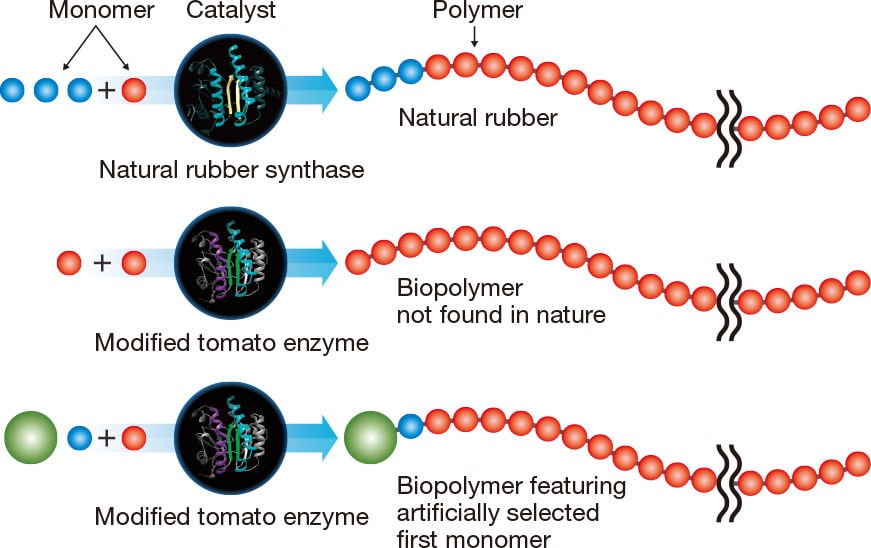
In collaboration with Tohoku University, Kanazawa University, Saitama University, and RIKEN, we compared the structures of tomato-derived enzymes, which belong to the same enzyme group and is structurally similar to natural rubber synthase, and enzymes synthesizing natural rubber to identify critical segment influencing rubber length. Furthermore, by replacing the critical segments of the tomato-derived enzyme with those of the natural rubber-synthesizing enzyme, we discovered that the modified enzyme can synthesize rubber of the same length as natural rubber. Additionally, by further advancing the research on this modified tomato-derived enzyme, we have successfully synthesized a biopolymer with a structure not found in nature.
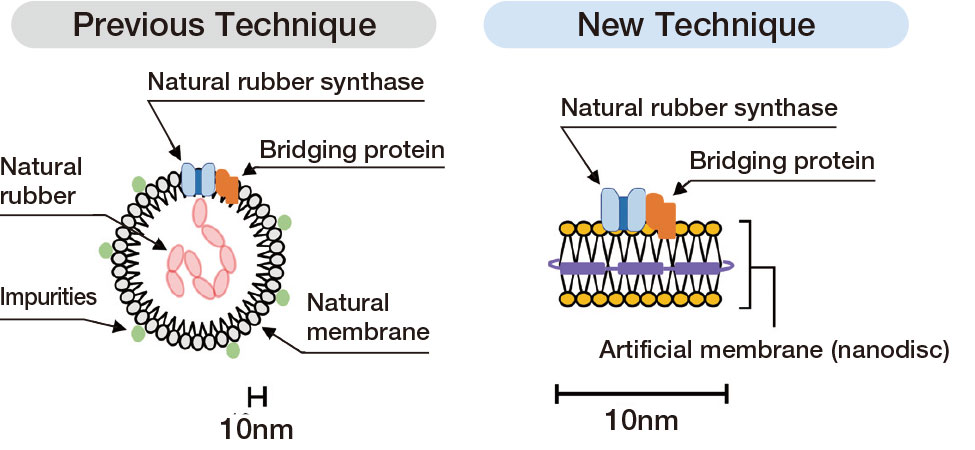
Through collaborative research with Saitama University, Tohoku University, and Kanazawa University, we invented a new technique for evaluating enzymes that utilize artificial membranes (nanodiscs). This new technique allows for much greater precision in evaluations compared to the conventional evaluation techniques that use natural membranes. We have also succeeded in activating the function of natural rubber synthases on these artificial membranes (nanodiscs).
In line with the DUNLOP Group’s Sustainable Natural Rubber (SNR) Policy, we have launched a joint research project with Khon Kaen University in Thailand starting in March 2024 as part of our efforts to improve natural rubber yields and achieve sustainable procurement of natural rubber. The most commonly used method for propagating rubber tree saplings is grafting, but the rootstock significantly influences growth and disease resistance. On the other hand, the tissue culture technology we are developing involves isolating specific tissues from rubber trees and culturing them in test tubes, resulting in plants with roots and stems that are part of the same plant body, which is believed to be advantageous for growth. Saplings derived from tissue culture have been confirmed to grow faster than those derived from grafting during the initial planting phase (1–2 years).
In this joint research with Khon Kaen University, we aim to investigate the growth and leaf shape of tissue culture-derived rubber tree saplings and grafted saplings, collect data on plant physiological responses, evaluate differences, and elucidate the mechanisms leading to yield improvement. Through this research, we will improve the production efficiency of natural rubber and accelerate our initiatives for sustainable natural rubber procurement.
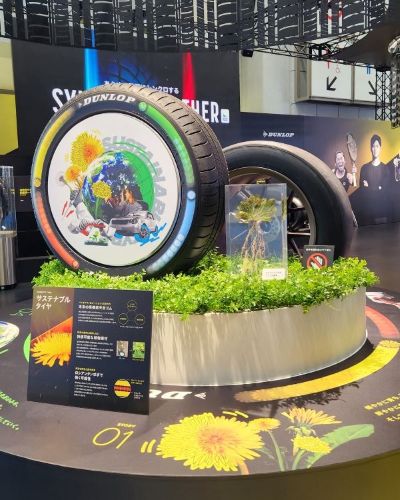
To deliver more environmentally friendly, high-performance products to our customers, we are focusing on the Russian dandelion as an alternative natural rubber resource to traditional Hevea brasiliensis. We have advanced a joint research project with the U.S. venture company Kultevat. Russian dandelions can be cultivated in temperate regions, allowing production in many areas worldwide, including North America. This joint research on Russian dandelion aims to promote the utilization of natural resources, diversify sourcing regions, and achieve stable, efficient procurement at each manufacturing site. This will enable us to deliver high-performance tires with a lower environmental impact. At the Japan Mobility Show 2025, we unveiled a concept tire incorporating a partial blend of Russian dandelion rubber.