DUNLOP Launches Joint Research on Sustainable Natural Rubber Production: Collaborating with Thai Research Institutions and Universities to Improve Productivity
Aug. 19. 2026
DUNLOP (Company name: Sumitomo Rubber Industries, Ltd.; President and CEO: Yasuaki Kuniyasu) is pleased to announce that it signed a joint research agreement in Bangkok, Thailand, on August 7, 2026, as a project under the Hevea Research Platform in Partnership (HRPP) *1, an international platform for natural rubber research. The other parties to the agreement are the Rubber Authority of Thailand (RAOT) *2, the French Agricultural Research Centre for International Development (CIRAD) *3, and Thailand’s Khon Kaen University and Kasetsart University.
This research project will investigate the effects of “low-frequency tapping systems,” which involves reduced frequency at which the raw material for natural rubber (i.e., latex) is collected (i.e., tapped) from rubber trees, on the quality and internal structure of natural rubber. It will also analyze the challenges faced by rubber farmers in adopting the systems, as well as the factors that could facilitate such adoption. Through this work, we will accelerate efforts toward sustainable natural rubber procurement.
The natural rubber industry in Southeast Asia faces challenges not only from fluctuating rubber prices but also from climate change and labor shortages. In Thailand, in particular, the shortage of workers who tap rubber trees to collect latex has become increasingly severe, with smallholder farmers growing more dependent on an aging workforce and migrant workers. The low-frequency tapping system is a method that reduces the frequency at which latex, the raw material for natural rubber, is collected (tapped) from rubber trees. Because it saves the labor required for tapping operations, it is expected to help address labor shortages in natural rubber-producing regions.
Studies have shown that, by using a plant growth regulator that stimulates latex production, tapping once every three days can achieve effective results in terms of productivity and rubber quality compared with the conventional practice of tapping once every two days. The findings from this research have been published in two peer-reviewed journal articles*4. Research is also underway on tapping once every four, six, and ten days; however, the quality and properties of the natural rubber produced under these tapping frequencies have not yet been fully elucidated. Further investigation is also needed into challenges associated with the adoption of such systems, including changes in cost and labor burden for rubber farmers and factors that could facilitate their adoption.
This project will investigate how varying tapping frequencies under the low-frequency tapping system affect the quality and internal structure of natural rubber, as well as the socioeconomic aspects associated with the adoption of such systems. We will apply the technologies and insights gained through this project to help advance sustainable natural rubber procurement.
■Overview of the Universties
To promote the sustainable procurement of natural rubber, we are conducting research and development on two fronts: improving productivity and improving working conditions (including at natural rubber processing facilities). As part of our efforts to improve productivity, we are advancing research on rubber tree seedlings using tissue culture technology*5.
Natural rubber is a form of natural capital and is used as a raw material in tires, the DUNLOP Group’s core product. To ensure a sustainable, long-term supply of natural rubber, we recognize the need for sustainable resource procurement that takes into account both QCD (quality, cost, delivery) and environmental and human rights considerations.
The DUNLOP Group has identified its material issues to put into practice “Our Philosophy,” our corporate philosophy structure. *6 Among the seven material issues identified by the Group are “Biodiversity” and “Human Rights,” through which we aspire to be “A group that understands its dependence on and impact on natural resources, such as natural rubber, and works to coexist with surrounding ecosystems” and “A group that respects the human rights of everyone involved with us.”
※1 Sumitomo Rubber Participates in HRPP as First Tire Manufacturer
※2 The government agency responsible for overseeing Thailand’s natural rubber industry. It promotes support programs for rubber farmers, research and development, and quality improvement initiatives.
※3 A public research institution that conducts studies and research on agriculture, the environment, and sustainable development, with a particular focus on tropical and Mediterranean regions.
※4 Part 1 , Part 2
※5 Sumitomo Rubber Begins Joint Research with Khon Kaen University of Thailand on Sustainable Natural Rubber
※6 Material Issues
This research project will investigate the effects of “low-frequency tapping systems,” which involves reduced frequency at which the raw material for natural rubber (i.e., latex) is collected (i.e., tapped) from rubber trees, on the quality and internal structure of natural rubber. It will also analyze the challenges faced by rubber farmers in adopting the systems, as well as the factors that could facilitate such adoption. Through this work, we will accelerate efforts toward sustainable natural rubber procurement.
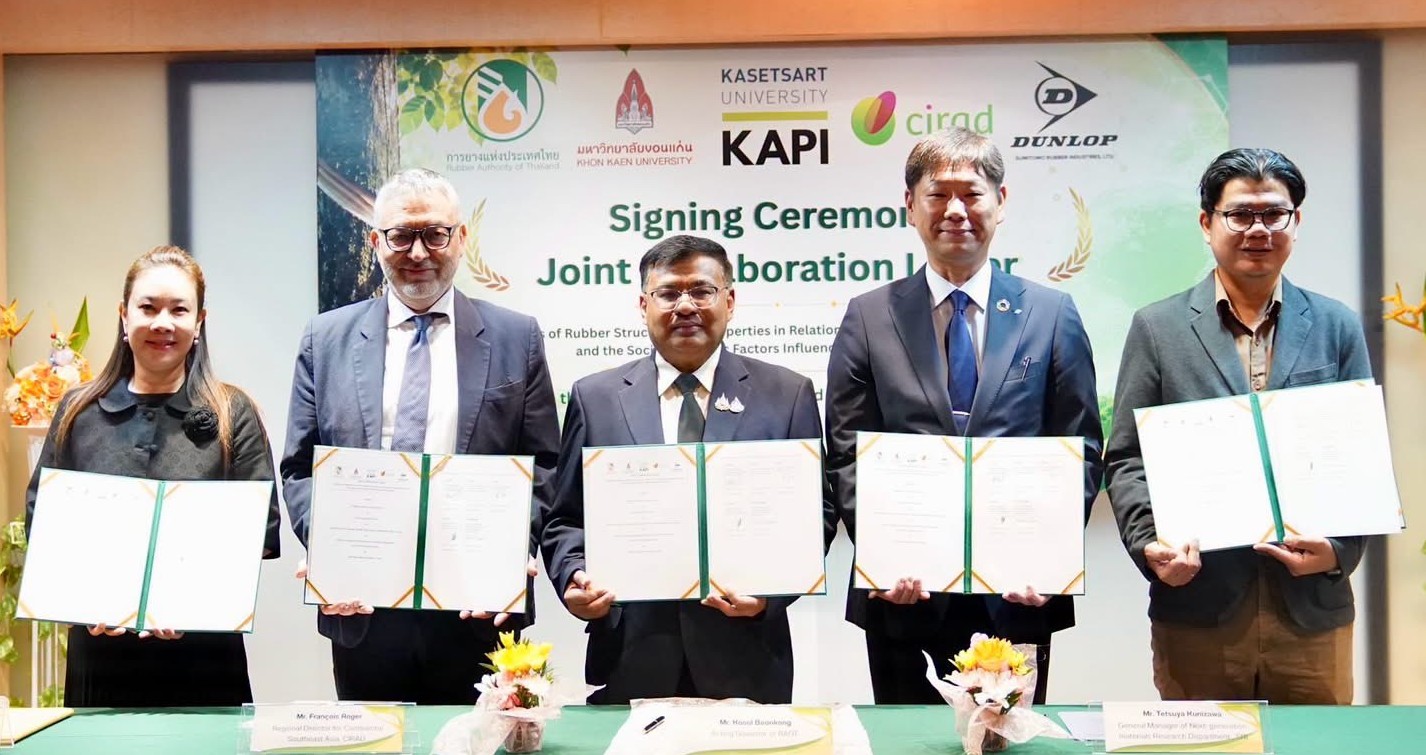 |
From left: Dr. Pilanee Vaithanomsat, Director of KAPI (Kasetsart Agricultural and Agro-Industrial Product Improvement Institute); Dr. Francois Roger, Regional Director of CIRAD; Mr. Kosol Boonkong, Acting Governor of RAOT; Dr. Tetsuya Kunizawa, General Manager of the Next-generation Materials Research Department, Sumitomo Rubber Industries, Ltd.; and Dr. Chaitheera Phanbhakdee, Assistant Professor, Khon Kaen University. |
The natural rubber industry in Southeast Asia faces challenges not only from fluctuating rubber prices but also from climate change and labor shortages. In Thailand, in particular, the shortage of workers who tap rubber trees to collect latex has become increasingly severe, with smallholder farmers growing more dependent on an aging workforce and migrant workers. The low-frequency tapping system is a method that reduces the frequency at which latex, the raw material for natural rubber, is collected (tapped) from rubber trees. Because it saves the labor required for tapping operations, it is expected to help address labor shortages in natural rubber-producing regions.
Studies have shown that, by using a plant growth regulator that stimulates latex production, tapping once every three days can achieve effective results in terms of productivity and rubber quality compared with the conventional practice of tapping once every two days. The findings from this research have been published in two peer-reviewed journal articles*4. Research is also underway on tapping once every four, six, and ten days; however, the quality and properties of the natural rubber produced under these tapping frequencies have not yet been fully elucidated. Further investigation is also needed into challenges associated with the adoption of such systems, including changes in cost and labor burden for rubber farmers and factors that could facilitate their adoption.
This project will investigate how varying tapping frequencies under the low-frequency tapping system affect the quality and internal structure of natural rubber, as well as the socioeconomic aspects associated with the adoption of such systems. We will apply the technologies and insights gained through this project to help advance sustainable natural rubber procurement.
■Overview of the Universties
| Name | Khon Kaen University | Kasetsart University |
| Location | Khon Kaen University 123 Moo 16 Mittraphap Rd., Nai-Muang, Muang District, Khon Kaen 40002,Thailand. | Kasetsart University,50 Ngamwongwanroad, Lat Yao, Chatuchak, Bangkok 10900, Thailand |
| Year founded | 1966 | 1943 |
| No. of faculties | 19 | 36 |
| No. of students | Approx. 40,000 | Approx. 74,500 |
| No. of faculty members and researchers | Approx. 11,500 | Approx. 9,900 |
* Figures for the number of students and faculty members and researchers are as of the end of 2025.
To promote the sustainable procurement of natural rubber, we are conducting research and development on two fronts: improving productivity and improving working conditions (including at natural rubber processing facilities). As part of our efforts to improve productivity, we are advancing research on rubber tree seedlings using tissue culture technology*5.
Natural rubber is a form of natural capital and is used as a raw material in tires, the DUNLOP Group’s core product. To ensure a sustainable, long-term supply of natural rubber, we recognize the need for sustainable resource procurement that takes into account both QCD (quality, cost, delivery) and environmental and human rights considerations.
The DUNLOP Group has identified its material issues to put into practice “Our Philosophy,” our corporate philosophy structure. *6 Among the seven material issues identified by the Group are “Biodiversity” and “Human Rights,” through which we aspire to be “A group that understands its dependence on and impact on natural resources, such as natural rubber, and works to coexist with surrounding ecosystems” and “A group that respects the human rights of everyone involved with us.”
|
|
 |
※1 Sumitomo Rubber Participates in HRPP as First Tire Manufacturer
※2 The government agency responsible for overseeing Thailand’s natural rubber industry. It promotes support programs for rubber farmers, research and development, and quality improvement initiatives.
※3 A public research institution that conducts studies and research on agriculture, the environment, and sustainable development, with a particular focus on tropical and Mediterranean regions.
※4 Part 1 , Part 2
※5 Sumitomo Rubber Begins Joint Research with Khon Kaen University of Thailand on Sustainable Natural Rubber
※6 Material Issues